Chapter 01
Anatolia
Rural excavation site
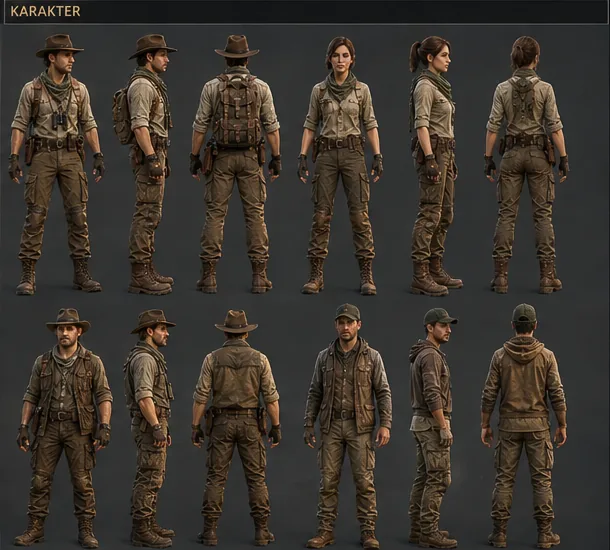
The first season. A small mound, a test trench and your first sherd. Everything is learned here.
Layered diggingYou start with a small crew, an old field vehicle and a few tents. By the end, you will have drawn the map of a civilisation history forgot.
In ARCHEVIA the most valuable thing is rarely gold. Sometimes a shard of inscription that fits in your palm rewrites an entire chapter.
You play a young archaeological field researcher. The first assignments are modest: a small rural site, a thin budget, a crew of three. But every artefact you lift and every line you read pulls you toward the next, larger discovery.
Not an action game in the Indiana Jones sense. Not a digging simulator where you only swing a shovel either. Somewhere between the two — grounded, atmospheric and story-driven.
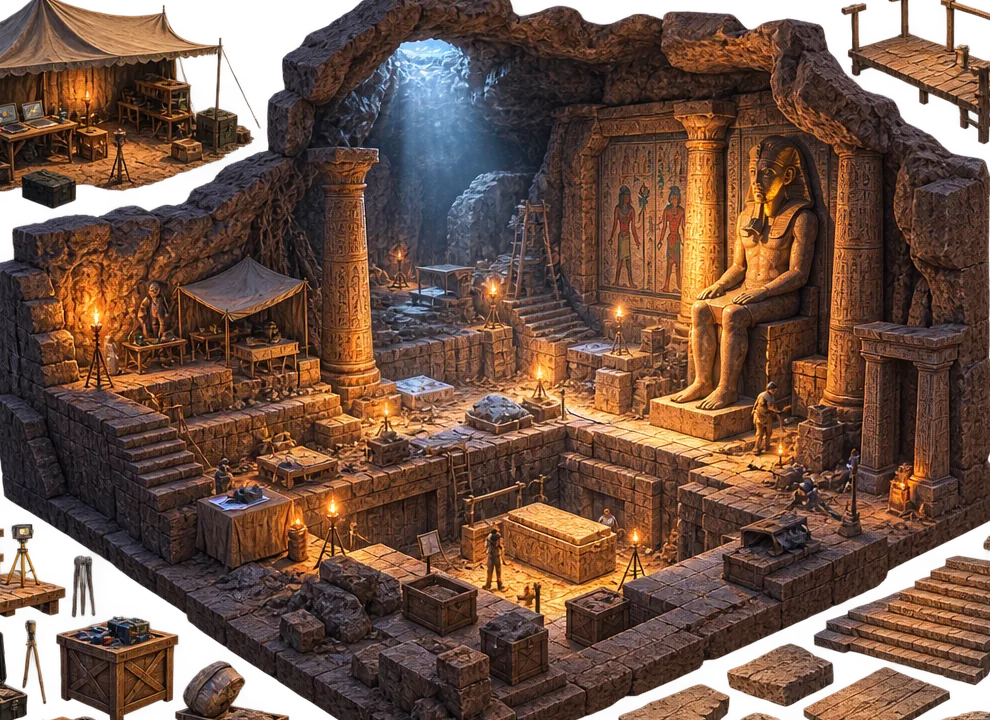
Stratigraphy, the right tool, the right order. Rushing costs you.
Eight regions, eight climates, eight different archaeological problems.
Finds that connect and lead to one question: who lived here?
Crew, budget, equipment and your own research centre.
Not a single lost treasure, but a career that spans years.
Every dig runs through the same ten steps. But no two sites are alike — and every step can be done wrong.
Study maps, old records, satellite imagery and notes from earlier digs. Excavation begins at a desk.
Walk the ground yourself. Read the colour and texture changes in the soil. The instruments give you a cross-section — never a certain answer.
Maps vegetation marks and soil discolouration from above.
Pin suspect coordinates and lay out the trench plan.
Shallow sweep for coins, weapons and metal goods.
Reveals voids and wall anomalies with a depth profile.
Colour, compaction and texture — a trained eye beats the instrument.
No surface finds
Late Roman, scattered
Regular block course — a wall
Signal breaks up, unreadable
Large void — enclosed volume
A trench opened in the wrong place does not just cost you time; it burns the season's budget.
The moment an artefact appears, the game slows down. Order matters, tools matter, patience matters. This is ARCHEVIA's real skill layer.
Take the loose fill back with a trowel. Never touch the artefact surface.
Narrow the boundary. Break up compacted fill by scraping.
Open the surface. Precision excavation begins here.
Find the true outline. Never lift before you know how far it runs.
Record it in place. Add scale, log the angle. This record never comes back.
Support it from below and raise it as one piece. Account for the weight distribution.
Cushion, label, crate. Move it safely to the camp store.
Pick the wrong tool and the artefact cracks. A cracked find can be restored — but part of the writing on it is gone forever.
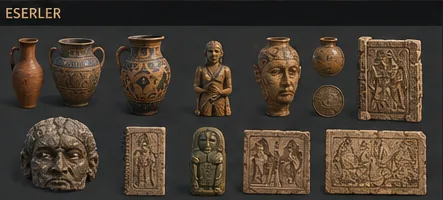
As your crew levels up, more complex regions open. Every specialist sees something on site that you cannot.
Field Researcher
The one who picks the assignment, builds the crew and decides where the trench opens. Every clue converges in your notebook.
Field Archaeologist
Reads how the trench should be opened and which layer belongs to which period. He is the first to notice a bad dig.
Geophysicist
Detects voids, walls and buried structures underground. Digging without his report is gambling.
Conservator
The second a find meets the air she is racing the clock. She rejoins what broke and halts what is decaying.
Documentation Lead
Nothing moves until it is recorded. An undocumented artefact scientifically does not exist.
Local Guide
Knows the ground, the weather and the tracks that never made it onto a map. Sometimes the best lead is a story from the village.
Gold is not the most valuable find. Sometimes a broken tablet says far more than a crate of coins.
The most reliable tool for dating a layer.
001Gives you dates, rulers and trade routes.
002Style, workshop and belief system.
003How a people buried tells you who they were.
004The most fragile scene under the floor.
005One line can change an entire chapter.
006Conflict, defence and metalwork.
007Proof of a life nobody wrote down.
008Names, titles and administration.
009Plan them out and a city appears.
010Volumes unopened for centuries.
011A single moment frozen under the sea.
012This inscription shows there was an unknown settlement right here.
And a brand new research chain opens on the world map.
ARCHEVIA's story is not built on one lost treasure. It is built from discoveries that connect — and you are the one making the connection.
A body fragment from the very first dig. Broken, cheap, nothing unusual for the period. Except for a small incised symbol at its base.
In the second region, kilometres away, the same symbol on the wall of a burial chamber. The odds of coincidence start to drop.
A broken tablet in the third region reveals that the symbol is not a workshop mark at all — it stands for a city, a people.
You are tracking a civilisation that appears in no history book.
And its centre is waiting for you in chapter eight.
The game does not stay in one place. As you progress the climate, the ground, the technique and the equipment all change.
As success arrives you build your own research centre. It grows season after season — and becomes the physical record of your career.
An old field vehicle, a few tents, basic excavation equipment and a crew of three.
9 × Centre
Dating, material analysis and symbol logging.
Rejoining breaks, cleaning and halting decay.
Every field notebook, photograph and solved clue.
The world map, open research chains and your next targets.
Crated finds and season equipment.
Where crew members specialise and unlock new abilities.
Aerial survey, equipment servicing and flight plans.
Field vehicles, trailers and site logistics.
The hall where every significant find of your career is displayed.
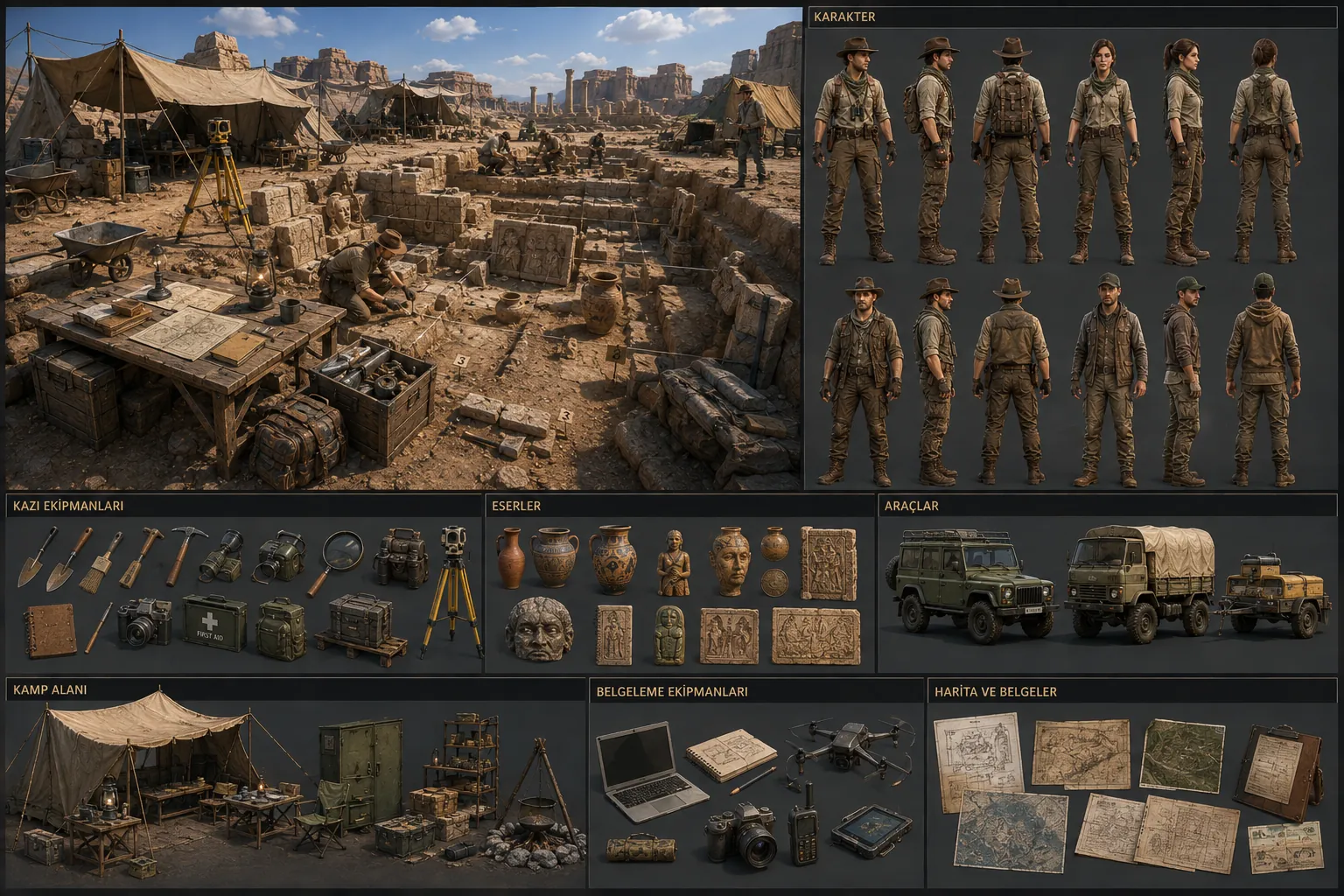
The important finds you bring back are displayed here. As the years pass the hall fills up; you'll see the cracked sherd from your first season standing beside the tablet from the final chapter. That, to me, is the strongest feeling in the game.
Walk the exhibitionThis is where the strongest moments in the game begin.
Screenshots, art direction studies and field recordings from development.
Visuals are from development and may not represent the final product.
An archaeology adventure simulator. Simulation, exploration, mystery, management and story layers all run together. It is neither a purely action-driven adventure nor a simulator where all you do is dig.
A real system. You descend layer by layer, pick the right tool in the right order, and a wrong choice permanently lowers the artefact's condition. All seven steps of the lifting protocol are playable.
No. Most of a season goes into research, survey, documentation, conservation and archive work. You also grow your own research centre and museum.
No. The central mystery is built from finds that connect. A symbol from one region reappears in a tomb in another, and the chain runs all the way to the centre in chapter eight.
Eight chapters: Anatolia, the Mediterranean, the desert, the highlands, forest, an underground city, a wreck, and finally the centre of the civilisation. Each is designed to feel visually and mechanically distinct.
Twenty-one languages, this website included: English, Turkish, German, French, Spanish (Spain and Latin America), Portuguese (Brazil), Italian, Polish, Dutch, Czech, Russian, Ukrainian, Simplified and Traditional Chinese, Japanese, Korean, Thai, Vietnamese, Indonesian and Arabic — with right-to-left layout for Arabic.
The game is in development. No release date has been announced yet — wishlist it or join the newsletter to hear first.
Sign up for announcements, development logs and closed test invitations.
ARCHEVIA announcements only. Unsubscribe any time.